Is AI changing the way we think about the human person? An interview with Nate Svogun
2025. December 04.

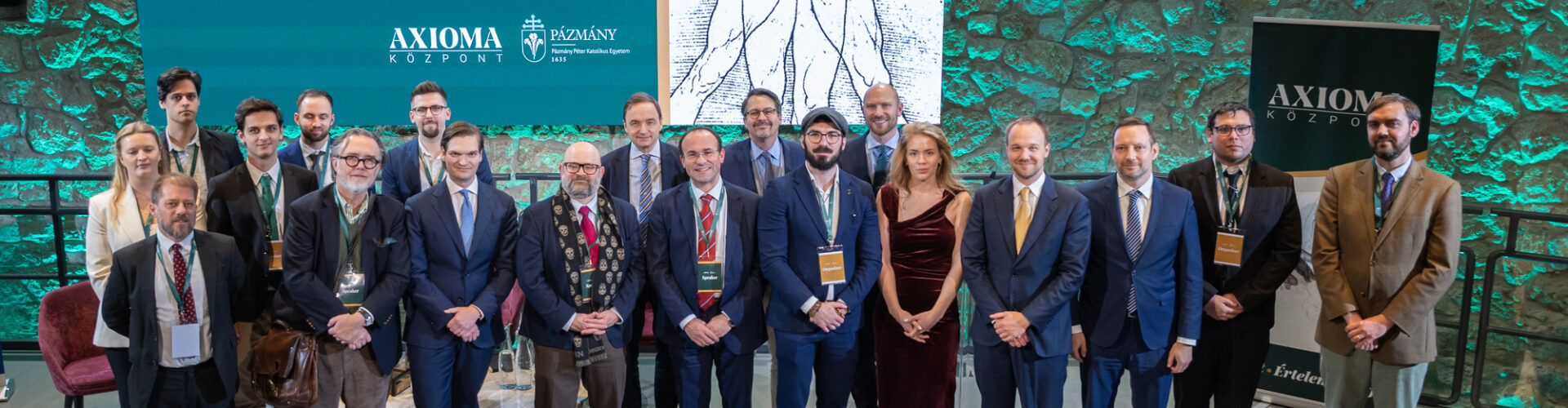
Nate Svogun is a program coordinator at the Institute for Human Ecology at The Catholic University of America which – drawing on the Catholic intellectual tradition – works to educate students, sponsor research and advise Church leadership. He participated in the “What It Means to Be Human” conference organized by the Axioma Center and Pázmány Péter Catholic University. In this interview, he reflects on his experience in Hungary, shares his views on AI, and explains the work the IHE is doing.
Coming into the conference, what kind of expectations did you have? Did you imagine a Christian think tank in a place like Hungary, which formerly had a socialist regime in power, playing a role in developing a shared understanding of what it means to be human for an ecumenical Christian audience?
Coming into the conference, I already had a fairly positive view of Hungary. I had done enough research myself to know that there were great things happening here – that there were reasonable restrictions on immigration, that the government wasn’t entirely swept up in the LGBTQ moment.
And I can certainly say I was blown away by the high quality of the work and depth of intellectual discussion on the panels. When I think of a Christian think tank, I typically think of an organization that is working primarily on a political level – and Axioma is doing that. But there was also so much theological and philosophical depth in the panel discussions I heard.
It truly felt like an academic conference, where people were coming together to discuss ideas and to seriously engage with questions of anthropology in a way that you don’t often see in political spaces.
I think Axioma’s level of depth and rigor will certainly just continue to be a asset for its future endeavours.
Speaking of what it means to be human, why do you feel that so many people are asking what would appear to be such a basic question? I mean, after all, if we were to go back, let’s say, 200, 300, even 500 years, it seems like this question would not have drawn much attention.
I think one of the obvious answers today is simply the fact that we see AI everywhere. The explosion of generative AI since the release of ChatGPT has definitely made all of us pause and say “Hold on – let’s take a step back”. And we need to, especially in somewhat adversarial terms. Those of us who don’t believe that ChatGPT is human have to go back to the fundamentals and say, “Here’s what being human actually is – and here’s why ChatGPT is not that.”
I also think in the last several decades, anthropology – at least in the American Academy, and I would guess in much of Western Europe as well – has been, for lack of a better word hijacked by woke social justice-oriented scholars. The focus is almost exclusively on race, class and gender. The fundamental truths about humanity that philosophers once explored, and that Christian anthropologists certainly explore, have been buried or even treated with hostility.
So I think it’s important to go back to the basics of the Western canon, because doing helps us reaffirm our understanding of the human person – especially as we engage with these new technologies that emerge every day.
What do you think are the latent challenges or dangers in modern society that are emerging in conjunction with AI? How do you view those, and what you think the future opportunities for engagement with them could be?
I think one current area of concern that intersects with AI is online gambling. I don’t think many people in the American intellectual sphere are fully aware of how significant this issue has become. I was recently looking at a survey by the American Psychiatric Association: more than a quarter of American adults – 28% – gambe online daily. The majority of these individuals are men. And 9% of adults reported gambling online for upwards of four a day. Four hours. And that’s 9% of all American adults.
This is an issue that disproportionately affects working-class and middle-class men, especially those from more impoverished backgrounds. And the fact that this has exploded to this degree makes it concerning that it hasn’t attracted the attention it deserves.
I’m sure AI is being used to make these platforms as addictive as possible. And unless there’s a real shift – some real education going on about how destructive this is – we are going to keep seeing this libertarian impulse of “Well, it’s their money, they can do what they want”. People argue it’s not as destructive to families as hard drugs, and I’m not going to quantify one over the other. But based on what I’ve seen among the young men I went to high school with, and what I’ve observed culturally, this has exploded. It’s a very serious social issue.
Please speak to us about how the IHE, contrary to the common criticism of lofty Christian theological teaching, not only imparts philosophical and theological propositions but also actively helps its researchers and fellows to excel.
The IHE is very big on practicing what we preach. We have many goals, but above all, we’re a community-building organization. The IHE supports graduate scholars, and we also have several media fellows and affiliated scholars at the faculty level. But I would say our primary goal is to build communion among the different members of those groups. And we do that through fellowships, seminars, pilgrimages, virtual events, and networking.
On that level, we’re truly living out our mission.
We’re trying to connect like-minded Christian scholars, bring great people into the same room, foster real relationships—and that’s what it’s all about.
For example, at our Civitas Day Fellowship, sitting at the closing dinner and walking around the room, seeing all the great conversations happening and people exchanging contact information—that’s community building, and it’s a beautiful thing.
A Journey into the Ivory Towers of Catholic America: reviewing the Civitas Dei Summer Fellowship
How is the IHE prioritizing the various tasks or challenges that its mission encompasses? How does the IHE decide what to address first and what to address second, from your perspective?
I would say that over the last few months—this is something that has really come to the forefront—we’ve begun taking a more intentional look at a task we had already been doing, but now want to approach with a much sharper lens. And that is making sure our graduate scholars land in excellent positions where they can be cultural influencers and reach large audiences. We know these people. We know they’re outstanding individuals and solid Christian thinkers. And in our own small way, we’ve helped form them along their paths. Now we’re taking a very focused approach to helping our IHE-affiliated graduate scholars secure strong job placements.
That might mean becoming a tenure-track assistant professor at a first-rate institution, where they can boldly and faithfully defend the Christian faith. It could mean joining an apostolate. It could mean joining something like Word on Fire Press. For instance, Jason Paion is a former IHE graduate scholar—now an IHE-affiliated full scholar—and he’s the Director of Word on Fire Academic, doing absolutely wonderful work there. We also prepare people to enter the political realm or to serve in church-related communications. One of the graduates of our M.A. in Human Rights is now the Director of Communications for the Diocese of Arlington.
As you can see, all these different fields have a real and measurable impact—on students attending classes with these professors, on the people who interact with the Diocese of Arlington through social media and press releases, and on Bishop Barron’s enormous audience at Word on Fire. Strengthening Catholic and Christian institutions that promote the word of Christ is really at the heart of what we’re doing. It’s a process that touches many threads. But the overarching aim is clear: to help place these scholars in positions where they will flourish, continue to grow, and positively influence others.
Essentially, the IHE’s preference is not to decide which issues you’re going to care about and which you’re not. Rather, you focus on cultivating the Christian talent—the Christian intellectual and spiritual strength—that comes to your door and that you can shepherd. Then you place them in positions where they can discern and rank-order these priorities in the hope of future good governance. Am I summarizing this correctly, or would you put it differently?
Yes, that’s a wonderful summary. I would just add that we recognize everyone has different talents. We have IHE-affiliated scholars who are outstanding experts in the philosophy of Thomas Aquinas, and their expertise naturally leads them to different areas of focus. Others, for example, are experts in Catholic architecture, which leads them down entirely different paths and toward different issues. But all of these areas are part of the same important mission we’re engaged in, and each person contributes according to their gifts.
And exactly as you said, developing a framework for nurturing Christian talent—and then sending them out into the world to boldly proclaim the gospel from a variety of perspectives, but always the gospel of Christ—is really what we’re all about.
Thank you so much, Nate Svogun, for your time. Are there any last words you would like to share with us in closing this interview from the IHE?
I would just say that the IHE would like to thank Axioma personally. I would also like to thank everyone at Axioma for their wonderful hospitality throughout this conference. I think this is the start of something truly meaningful. Axioma is doing great work in the political sphere, and they’re doing it through an authentic Christian lens.
And honestly, we need more Axiomas—not only in Hungary, but around the world. So thank you very much for the great work you’re doing.
More essays
Open Letter from Twenty-One Pro-Life Organizations to Dr. Zsolt Hegedűs, Hungary’s Minister of Health
Subject: Abortion Pill, Fetal Heartbeat Regulation – Pro-Life Organizations Excluded from Consultation Dear Minister, We have learned that today the Ministry of Health held a consultation regarding...

Rising antisemitic violence in western Europe: lessons and warnings for Hungary
Last Wednesday, London’s Jewish community was rocked once again by an appalling instance of extreme antisemitic violence. Essa Suleiman, a 45-year-old British citizen of Somali...
Remarks by Senior Researcher Wael Taji Miller “What the Crisis of Migration Means for Families and Nations”
We are pleased to share the transcript of a speech delivered at the Hungarian Embassy in Washington, DC, where two of our latest white papers...