What happens to a society when it forgets what it means to be human? Interview with Dr. Christiaan Alting von Geusau
2025. December 11.

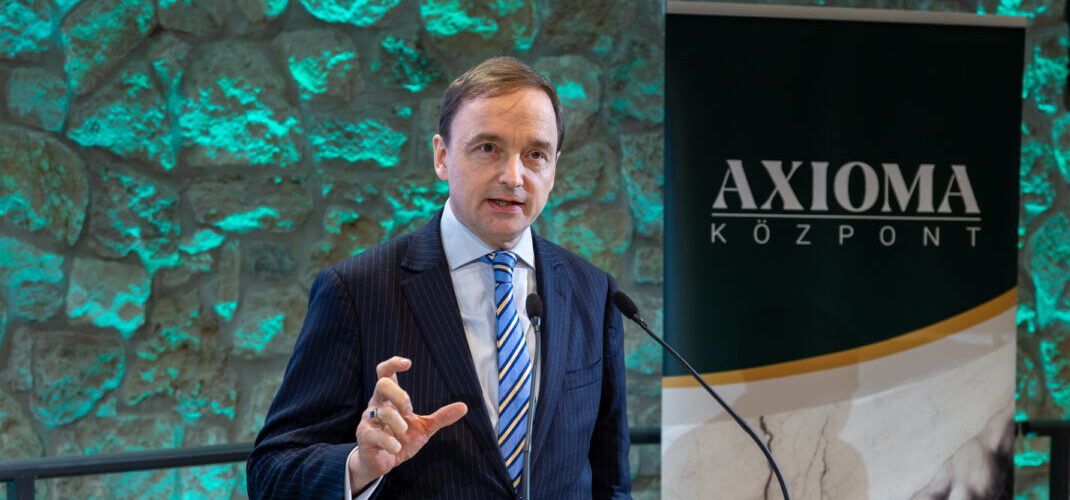
Dr. Christiaan Alting von Geusau is President of the International Catholic Legislators Network (ICLN) and Managing Director of Ambrose Advice, a company that provides strategic geopolitical advisory and leadership training. Dr. von Geusau is Rector emeritus and Professor of Law at ITI Catholic University in Austria and Honorary Professor of Law at the Univerisdad San Ignacio de Loyala in Peru. Dr. von Geusau recently participated in the What It Means to Be Human conference organized by Axioma Center and Pázmány Péter Catholic University. In this interview we ask him about the Christian idea of the human person, education and the role of digital devices in formation.
What kind of expectations did you have coming into the conference? How did you imagine a Christian think tank playing a role in developing a shared understanding of what it means to be human?
I feel my opinion is somewhat unique because I had never encountered a Christian think tank led by someone with the level of zeal for the gospel that Áron has. So, I really didn’t know what to expect. However, there was one thing I was confident about: the discussions would be at a high level. That’s where my expectations essentially stopped. I wasn’t sure how the topic would be tackled in the format of a one-day conference, given the scope of the questions — questions that are, in fact, central to our daily lives.
You have long been part of the academic world, where you have had a distinguished career. As a university student, could you have imagined that even in 2025 we would still need to ask such fundamental questions?
Well, I would say I certainly did not expect that to happen. But what I did see happening — and what kept my mind open to this question throughout my studies and professional career — was the transformation I witnessed growing up in the Netherlands. As I grew up, I saw firsthand how what was once one of the most religious countries in Europe was changing. It’s a little-known fact, but in the 1950s the Netherlands had one of the highest levels of church attendance in the world, with the Protestant north and the Catholic south.
What I observed over the years was how this religious and social structure was gradually being dismantled. I saw the church literally falling apart as an institution, and I watched secularization take hold. The societal structures on which Dutch life had been built — structures underpinned by shared principles and a common moral framework — were being eroded one by one.
So even though I didn’t yet fully understand that this was connected to the deeper question of what it means to be human,
I clearly saw what happens to a society that more or less rejects the necessity of that question.
Because religion is, in many ways, precisely about that question. Instead, society shifted into a fully materialistic mode: the idea of a ‘makeable’ society — that we can create everything ourselves.
And I must say, it’s thanks to my parents that, in the midst of that spiritual jungle, they were able to raise us with a sense of depth. We happened to belong to one of the few remaining active parishes, and our catechists introduced us to the broader Christian intellectual tradition. For me, it really began as a young student when I became involved in the Phoenix Institute, an organization specifically focused on these fundamental questions, offering courses and programs that shaped my thinking.
If we take a truth for granted, it is easy to forget its significance. How likely do you think it is that there will once again be a consensus on the nature of humanity?
In my youth I quickly learned that nothing in this regard could be taken for granted. We were growing up as a family in a society that had once been very strongly Christian but was disintegrating around us. We had to walk that road ourselves — to search, to wrestle, and eventually to make a personal decision about whether this was indeed the path we wanted to follow. Looking back, that was an advantage. Faith was not something automatically handed to me; it was something I had to search for, understand, and even defend.
I stand very much in the school of Pope Benedict XVI. I even used this quote in my lecture at the conference. When he addressed the German Parliament in 2011, he said that unlike some other monotheistic traditions, Christianity does not impose a revealed legal order upon society.
Instead, it points to nature and reason as the foundations of law and the organization of our common life.
And of course, the presupposition is that this natural order is rational and intelligible.
In a society that is not only non-religious but often religiously illiterate — a society that does not know what to make of religion — people easily run after all sorts of ideologies. They cannot distinguish one worldview from another, one religion or school of thought from another, because they feel a kind of inner emptiness, a lack of hope.
Now, I hasten to add that the core message that Pope Benedict gave is really just repeating what Saint Paul says in the New Testament: that God’s law, the natural law, is written in our hearts. We simply need to help people find the doors that allow them to open that understanding. The best way we can reach a society that is mostly post-Christian, sometimes anti-Christian is the same way the early Christians did: by the way we live.
Maintaining concentration and attention among young people seems to be a serious challenge, made even more difficult by AI and the world of online micro-communities. What responses can we offer to this at both the individual and community level? For example, Australia recently banned social media use for those under 16. Could this be a solution?
I’ve been following this with great personal interest because here in Austria, in 2012, I founded a Catholic high school. One of the first policies we implemented was a complete ban on smartphones, tablets, and similar devices. That was thirteen years ago, and at the time, people laughed at us and mocked the idea. Nowdays many countries are introducing bans on smartphones and tablets in classrooms. And the results? Our students actually interact with one another. During breaks, they talk, play board games, or go outside to play soccer on the field.
From a policy standpoint, banning devices until a certain age is a good thing — if you offer a meaningful alternative.
Interestingly, a large majority of young people who eventually found their way into the Catholic Church were first introduced online — through Bishop Barron, Word on Fire, or other excellent online ministries. Many started online, and from there they were drawn into local communities, where they began meeting people, growing in faith, and preparing for baptism. With AI and other technologies, there are enormous opportunities here — opportunities that must be used wisely.
I’ll close with this thought: we must remember that, like Christ, it’s one soul at a time. I’m not saying we should aim for mediocrity, but we should focus less on numbers and more on how each of us, in our specific calling, can contribute to bringing people to Christ.
More essays
Open Letter from Twenty-One Pro-Life Organizations to Dr. Zsolt Hegedűs, Hungary’s Minister of Health
Subject: Abortion Pill, Fetal Heartbeat Regulation – Pro-Life Organizations Excluded from Consultation Dear Minister, We have learned that today the Ministry of Health held a consultation regarding...

Rising antisemitic violence in western Europe: lessons and warnings for Hungary
Last Wednesday, London’s Jewish community was rocked once again by an appalling instance of extreme antisemitic violence. Essa Suleiman, a 45-year-old British citizen of Somali...
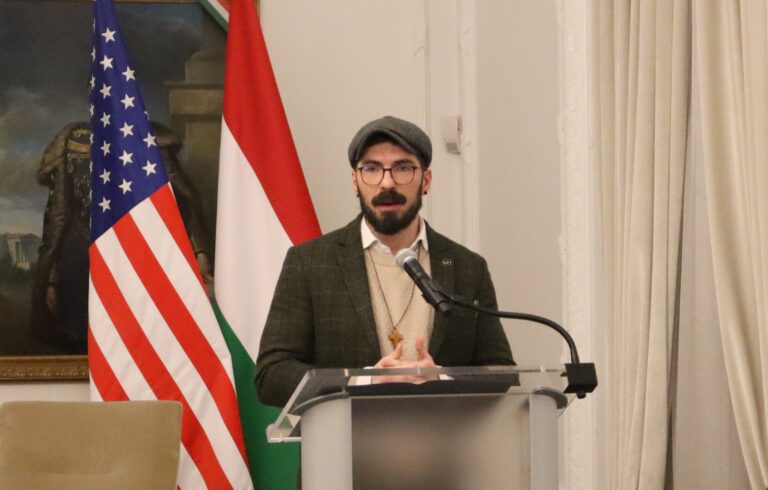
Remarks by Senior Researcher Wael Taji Miller “What the Crisis of Migration Means for Families and Nations”
We are pleased to share the transcript of a speech delivered at the Hungarian Embassy in Washington, DC, where two of our latest white papers...