A Journey into the Ivory Towers of Catholic America: reviewing the Civitas Dei Summer Fellowship
2025. October 09.

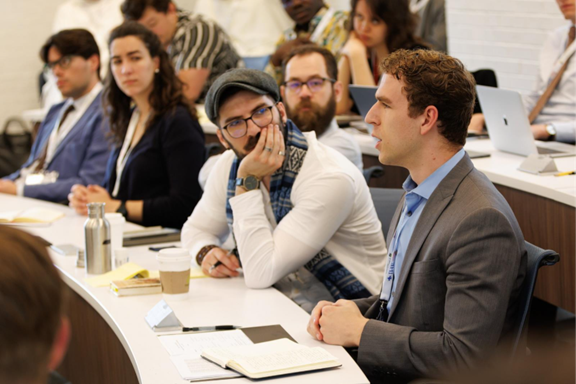
On June 7, 2025, I stepped onto a plane departing from Budapest, heading west. Upon landing in Zurich, I rushed to catch my connecting flight, and took off in economy for Washington D.C. Admittedly, I was nervous. It was the first time I had been home in four years. It had been decades since I visited D.C. as a child – an experience I no longer remembered. But I had other reasons to be anxious, besides.
I was embarking to our nation’s capital to participate in the Civitas Dei Summer Fellowship program, run jointly by the Institute for Human Ecology (IHE) at the Catholic University of America (CUA), and the Thomistic Institute (TI) at the Dominican House of Studies (DHS).1 Each year, the program has a different theme and title: in 2025, it was ‘The Future of Personhood and the Ethics of Artificial Intelligence: Augustinian, Thomistic, and Contemporary Perspectives.’ I didn’t know what exactly a Thomistic perspective was at the time (this will become important later) but after years of experience with generative AI in diverse contexts – data science, script coding, image generation, and private sector projects –
I knew that I needed to step back and ground my approach to the tech from a base that would be solid, fundamental, and true.
The spark that lit my path in AI research was ignited in August of 2022, when a story gaining traction in the mainstream media caught my attention. A graphic designer in Colorado by the name of Jason West had submitted an entry to the Colorado State Fair Fine Arts Competition in the “digital arts/digitally-manipulated photography” category, and had scored first place. After winning the competition in August, the designer subsequently acknowledged that his submission was created using generative AI. West not only disclosed to the public the prompted nature of his creation – he defended it.

Reading through the news coverage of the affair back in 2022, I knew instinctively that the world as I knew it had changed. I dived into Stable Diffusion and other diffusive image-generation models obsessively for roughly two months. Somehow, my work ended up bearing fruit.
My first published article on generative AI was printed in late 2022, in the journal of the Hungarian Conservative (Vol. 2, No. 6.). By chance, the editor had asked for an article on the topic of innovation – I duly followed and submitted my article, heavily over the word limit, on October 17, 2022. Just one month afterwards, in November, ChatGPT was released and made available to each and every internet user worldwide. By the time my piece was eventually republished online in May of 2023, the world had already changed beyond recognition.
Technological progress, as it just so happens, has in some ways stayed true to my 2022 observations and predictions. While I admit that my terminological novelties and referential frameworks for dealing with AI never caught on, nor got any traction in the online sphere, the predictions from 3 years back seem more true now than ever before. The final paragraph, then considered speculative fantasy, now considered doomerism, reads as follows:
“For this reason, we may also surmise that in such a paradigm, the models [gen-AI models like ChatGPT] will eventually decay into stagnation. Gradually, as human creative output diminishes and we become more reliant upon GAIMs [Generative AI Models], the stagnancy of these models will have only one solution—we update the models with inputs produced by the models themselves. This, in other words, leaves us with the eerie possibility of entering a paradigm in which originality and creativity die off, and we are locked into the use of these stagnant, soulless machines; content generating models that eventually become trained entirely on inputs produced by other content generating models.
It would be the end of innovation as we know it, and regardless of who or what ‘generates’ the obituary for innovation, one may be assured of what it will read: ‘Death by suicide.’”
This gloomy prediction was written before ChatGPT existed. It was written years before the Western world came to acknowledge the concept of ‘AI slop’ – something that not only interferes with our everyday internet-linked lives as of now in 2025, but also something which acts as an obstacle to our collective attempts at consensus-making and truth-seeking: both of which are core tenets for any society which aspires to live up to Christian values.
My flight landed in Washington with ease; no turbulence, clear skies. Two and a half years after my first tackle with artificial intelligence, I found myself in our nation’s capital, ready to learn what my Christian faith had to say about a problem that our treasured technology companies simply dumped on the human race – altering the present and future states of all humanity on a global scale, without ever asking for ethical approval, or even popular consent.
The Civitas Dei Summer Fellowship program is organized by Catholic Christian institutions – the IHE, and the TI, as mentioned earlier. As a Coptic Orthodox Christian possessing little familiarity with Roman Catholicism, I anticipated some issues or difficulties could arise during my time in the program. To my credit, I did indeed encounter some difficulties – but not of the kind that I expected.
Monday (June 9 2025) was one such example. A priest I knew from the program brochure as Father James Brent – of the Dominican Order – gave an introductory lecture to a packed room of fellows who knew each other not from Adam, neither from Eve. All but two were Catholics; all were devout Christians (or at least on the way there). From that point onward, I strived to learn what AI means for us as individuals, and as social collectives, on a level that was inconceivable for me back in 2022 while writing my first AI publication.
In the first lecture, on the first day, I found myself humiliated. The story goes as follows. Father James Brent was, simply put, too interesting. I realized fully well that I was taking part in a fellowship principally aimed at, and offered by, good Catholics – a Christian people who I had virtually no prior knowledge of. Yet despite being a non-Catholic, I simply couldn’t swallow down my questions on certain key topics elevated by Father James’s lecture. I was not the first to raise my hand and ask, but when I spoke, everyone laughed. My phrasing was poor. I asked how “Aquinians” viewed a certain problem in the philosophy of mind and machine; I should have said “Thomists”. Oops.
Somehow, I understood that the laughter wasn’t cruel. Far from it – it was comforting. After I attentively listened to Father James Brent’s answer to my query, as the lecture concluded, more than five fellows (other students) approached me and warmly educated me about the terminology they use. “Thomists” not “Aquinists.” This was just the very first experience in my week-long education on the problematic phenomenon of generative AI, but
it was also the first step in my education on the heart and soul of Catholic America.
Being born and raised in a non-Christian family, I came to believe during my final year as an undergraduate at Cambridge University. While pursuing my studies in Asian & Middle Eastern languages and cultural psychology, I somehow found myself entangled with early 20th century analytical philosophy, and with the thought of Ludwig Wittgenstein. Well before I reached the conclusion of Wittgenstein’s Tractatus Logico-Philosophicus, I found myself traumatized by a realization. Namely: God not only exists; He must exist. Christ not only died for our sins; He needed to do so. Grace, above all else, was a mystery to Wittgenstein, probably because of his brutally analytical outlook on existence and the human person. It was a mystery for me as well, until I consigned myself to the Oriental Orthodox faith.
After spending almost a decade as a catechumen (including a period of two years attending an illegal house church in China at risk of arrest and without receiving the sacraments) I finally received the baptismal sacrament and fully joined the Coptic Orthodox Church in 2021, while on an extended pilgrimage in Egypt. It took place at a monastic complex housing the southernmost point traversed by the Holy Family during their refuge in Egypt (Deir el-Muharraq). Being baptized in the faith after prolonged study and patience is one thing. Being fortunate enough to experience this in that specific place was quite another thing entirely.
When I signed up for the Civitas Dei program, these two aspects of my intellectual and spiritual background – my engagement with AI, and my journey into faith independent from the Roman Catholic Church – gave me a confidence that I didn’t deserve. On that first day in the program, I found myself fascinated, humbled, and then gently corrected; a process which would repeat itself again and again throughout each day of lectures, as well as during seminars, field trips, and genuinely thrilling discussions.
In terms of generative AI and its hazards, our instructors did not take us down a dark road into apocalyptic doomerism: that would have been far too easy.
Rather, the lectures and their content focused on the boundaries of human agency and being, as understood in Catholic theology, and harmonized this with relevant cognitive science and Aristotelian philosophy. Instead of focusing on AI in technological and coding terms, we were given a thorough education on the definitional structure of what exactly it means to be a human person – psychologically, philosophically, and theologically – in contrast to LLM machine ‘reasoning’.
As a perennial pessimist with a penchant for focusing on the ‘bad things’ we as Christians must stand against, I was surprised to find myself spiritually and intellectually fulfilled with a very different structure of discourse on the frontier technology of AI: one that instead focused on truth and reason as ‘good things’ we ought to protect.
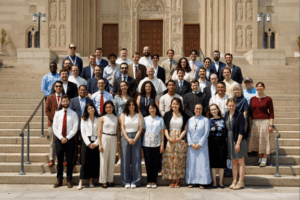
Although it would require a small booklet to summarize my learnings from the courses and conversations that Civitas Dei gave me during that one short week in the summer of 2025, what stuck with me above all were the people themselves. A professor showed me the intellectual fierceness and casual lightness of the academic Catholicism I had been missing out on. A priest who could have been a football player or MMA heavyweight exhibited unreasonable patience in tolerating both my incessant questions, and that one time when I set off the fire alarm during Eucharistic Veneration. My fellow students – with whom I often conversed into the late hours – elevated my definitions for ‘quality conversation.’ Overall, I quintupled my lifetime attendance at Catholic mass during the program (going from a grand total of 3 to a solid 15).
In closing, I thank both the IHE and the TI, along with their incredible staff, for organizing a truly remarkable fellowship experience. The impact on my fellow students – even the most veteran intellectual Catholic future leaders – was palpable. The impact on me, an outsider journeying into the beating heart of Catholic America, together in fellowship with its best, brightest, and most faithful, is such that I’m not sure I can refer to it in the past tense.
More essays
Remarks by Senior Researcher Wael Taji Miller “What the Crisis of Migration Means for Families and Nations”
We are pleased to share the transcript of a speech delivered at the Hungarian Embassy in Washington, DC, where two of our latest white papers...

What happens to a society when it forgets what it means to be human? Interview with Dr. Christiaan Alting von Geusau
Dr. Christiaan Alting von Geusau is President of the International Catholic Legislators Network (ICLN) and Managing Director of Ambrose Advice, a company that provides strategic...

Is AI changing the way we think about the human person? An interview with Nate Svogun
Nate Svogun is a program coordinator at the Institute for Human Ecology at The Catholic University of America which - drawing on the Catholic intellectual...