Rising antisemitic violence in western Europe: lessons and warnings for Hungary
2026. May 06.


Last Wednesday, London’s Jewish community was rocked once again by an appalling instance of extreme antisemitic violence. Essa Suleiman, a 45-year-old British citizen of Somali origin, came to the North London neighborhood of Golder’s Green (recognizable to Londoners as the beating heart of Jewish life in the capital city) and, finding two Jewish men on the street, stabbed them with intent to kill. Suleiman was arrested for attempted murder, and the attack has now been classified as an instance of domestic terrorism by British police. Fortunately, both victims survived and were taken to hospital, and are now on the road to what will hopefully be a smooth recovery.
From where I sit and write in the Jewish quarter of Budapest, it is striking how remote events such as these feel to the community around me. Horrific incidents of antisemitic violence such as these are not at all rare – unfortunately, one thing we can be certain about is that the April 29th attack might be the latest, but it is unlikely to be the last. Yet there is more to learn specifically about the nature of this pattern of violence by studying the perpetrator – that is, Essa Suleiman.
45-year-old Suleiman came to Britain from Somalia as a child, subsequently acquiring British citizenship. He was raised in British public schools and with the benefit of British public institutions. Yet prior to his attack, he had been living in state-funded accommodation for people who are coming out of “secure hospitals” – a term that is commonly used to denote both forced and voluntary psychiatric hospitalization. Typically, such circumstances are associated with long and deeply troubled personal histories; struggles with mental illness, drug abuse, and permanent unemployment are all common here.
What is perhaps most important of all for understanding this terrorist attack is the fact that Suleiman did not start off his day with a documented plan to kill Jews.
Perhaps such a plan may have existed, but the facts are not conclusive. What is conclusive is that Suleiman began that morning by repeatedly phoning and then visiting a former friend, a Muslim man, in a very different part of London: Southwark. After gaining entrance into his estranged friend’s house, Suleiman attempted to kill him by stabbing him in the upper body; the victim fended off the attack and then fled to a local hospital. It was only after this initial attempt at murder failed that Suleiman took public transport to the most prominent and well-known area of Jewish life in London, clearly committed to taking the lives of any Jews he could find.
What this incident reveals is that antisemitic violence in Western Europe is often not as clearly purposeful as we might imagine.
Rather, the pattern is one in which violent and unstable individuals of Muslim background hit rock bottom (psychologically, financially, criminally, or even romantically in some cases) and experience a certain ‘point of no return’. Having reached this, they decide to channel their final reserves of willpower toward a concrete, explicit purpose, perhaps the only purpose they have left at that point in their lives: to hurt or kill as many Jewish civilians as they possibly can.
Suleiman’s life was probably not an easy one.
Today, we look at refugees and immigrants from Muslim-origin countries in light of the past 11 years of ‘refugees welcome’ policies, and generous welfare handouts. We do not often think of the struggles that a Muslim Somali child or family would experience in coming to London in the 1990s, when institutions still functioned and society at large still had a coherent identity. To go from an Islamic, semi-literate, clan-based society into a metropolitan urban meritocracy is no easy feat. Based on Suleiman’s hospitalization and living situation prior to the attack, it appears eminently clear that he (and perhaps his family members also) were unable to smoothly transition into life in his new adoptive homeland, and became stuck somewhere in-between the cultural gulf that separates Somalian clans from British urbanism.
The abject failure of Suleiman and those like him to acclimate to existence in secularized Christian European living is no excuse for the atrocious acts that he committed. But it does reveal certain facts. One of these facts is that, for some individuals of a certain cultural and religious background, if life doesn’t pan out in accordance with personal expectations, the first resort or inclination is to exact revenge upon the world by committing murderous violence against the closest Jew that can be found. This means that if developed countries continue to welcome – as refugees or as illegal migrants – people from these backgrounds, and they experience ‘failure to launch’ syndrome, Jewish individuals and communities are the most likely to suffer as a consequence of this border mismanagement.
Another fact that is made crystal clear here is that ‘magic soil theory’ (that simply relocating from one’s ancestral home in the tribal societal context of Somalia or Afghanistan into Christian Europe) is not correct. Proponents of this utopian theory, under which migrants and refugees welcomed into European soil could become the next John von Neumann or Paul Erdős, have historically failed to consider the fact of cultural proximity in their analysis (that is, the degree of distance between the culture of the immigrant household and the culture that prevails in the new home into which they move). The concept of cultural proximity, as discussed in a forthcoming paper by Guy Dampier of the Prosperity Institute and Kristen Ziccarelli of the America First Policy Institute, is a metric whose importance went unrecognized by the British immigration authorities that admitted Suleiman and his family in the 1990s; had it been understood back then as clearly as it is now, neither the attack at Golder’s Green – nor the collective suffering of London’s Jewish community engendered by it – would ever have happened.
In Hungary, the Tisza government of Magyar Péter, who is set to be sworn in this month, has pledged to take a hard line on migration consistent with the stance set by the previous Fidesz government – a stance with which many European countries even in the West now sympathize. As we described in our 2025 whitepaper ‘Migration and Ethics: the Axioms of a Christian Migration Policy’ left-wing governments in countries such as Denmark have tacitly and explicitly acknowledged the unsustainability of the 2015-era migration consensus, in which refugees were unconditionally welcomed, and any complications arising from their presence in Christian Europe was dismissed or downplayed as mere ‘transitional issues’. It is up to Hungary’s new government to ensure that the Jews I live with and break bread with in Budapest’s 7th district do not find themselves confronted with foreigners who perceive their personal problems in life as just cause to commit themselves to antisemitic terrorist violence.
More essays
Open Letter from Twenty-One Pro-Life Organizations to Dr. Zsolt Hegedűs, Hungary’s Minister of Health
Subject: Abortion Pill, Fetal Heartbeat Regulation – Pro-Life Organizations Excluded from Consultation Dear Minister, We have learned that today the Ministry of Health held a consultation regarding...
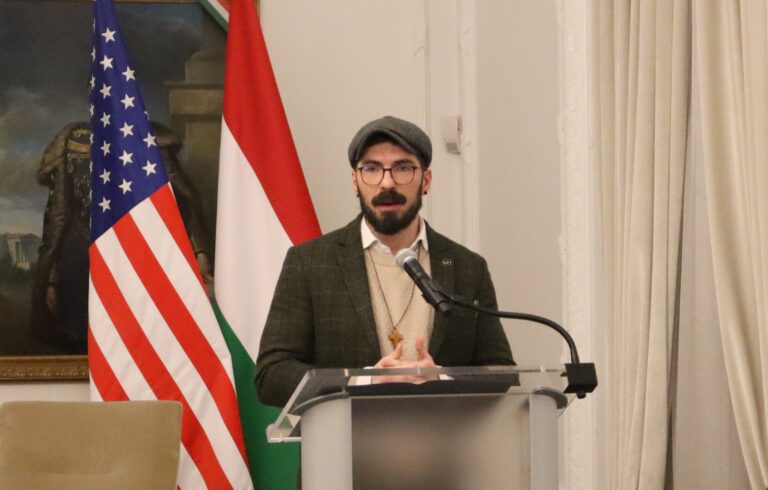
Remarks by Senior Researcher Wael Taji Miller “What the Crisis of Migration Means for Families and Nations”
We are pleased to share the transcript of a speech delivered at the Hungarian Embassy in Washington, DC, where two of our latest white papers...

What happens to a society when it forgets what it means to be human? Interview with Dr. Christiaan Alting von Geusau
Dr. Christiaan Alting von Geusau is President of the International Catholic Legislators Network (ICLN) and Managing Director of Ambrose Advice, a company that provides strategic...